This page reframes the event around what matters most now: the themes, technologies, and commercialization signals shaping Canada's mining innovation trajectory.
Date
Tuesday, June 9, 2026
Location
Fairmont Chateau Laurier, Ottawa
Format
Post-Event Resource
MICA Program Results
500+
Organizations engaged across the national network
70
Innovation projects supported since launch
$274M+
Investment mobilized through ecosystem collaboration
122
Pieces of intellectual property supported
Opening voices
The leadership that set the tone
Viviane Lapointe, Claude Guay, and Paul Lefebvre framed the day around commercialization, public leadership, and the practical pathways that move MICA projects into market impact.
MP for Sudbury
Viviane Lapointe
Opened the day by framing Sudbury as a centre for mining innovation, commercialization, and critical minerals leadership.
The countries that will be strongest in the decades ahead will be those that can transform critical minerals into innovation, technology, and industrial capacity.
Parliamentary Secretary to the Minister of Energy and Natural Resources
Claude Guay
Connected critical minerals policy to innovation, processing, and the need to create more value from every advantage Canada already holds.
With the right projects, the right partnerships, and continued investment, we can strengthen our position and deliver long-term economic value for Canada.
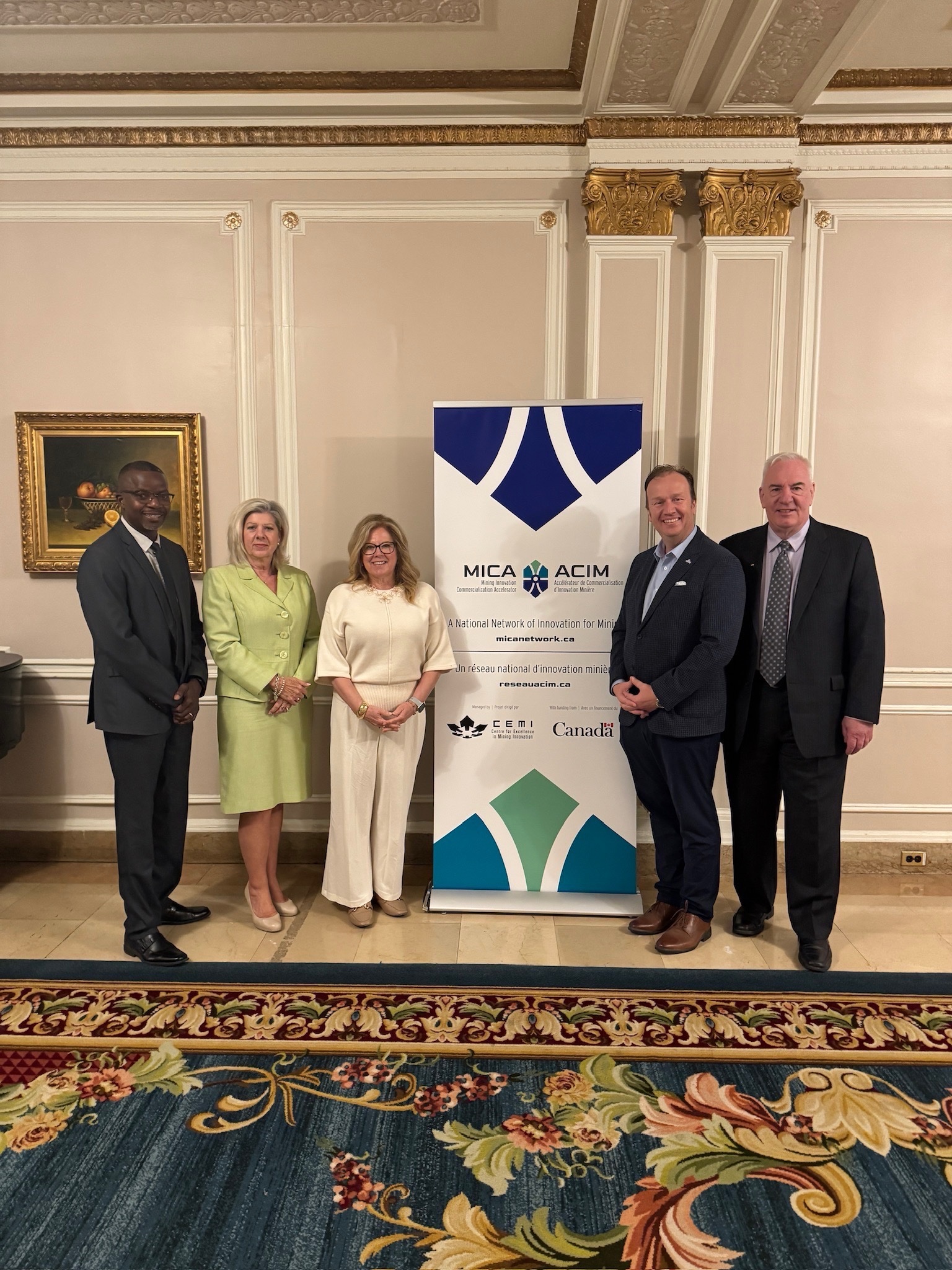
Panel photo
Mayor of Greater Sudbury
Paul Lefebvre
Reinforced Sudbury’s commercialization ecosystem, the role of partnerships, and the need to turn innovation into deployment.
With the right projects, the right partnerships, and continued investment, we can strengthen our position and deliver long-term economic value for Canada.
Panel discussions in focus
Three in-depth panel discussions anchored the day. Each panel provided insights, expert analysis, and lived experience in supporting innovative technologies.
Panel discussion
Scaling Canadian Mining Technologies
Panelists explored the commercialization gap between strong Canadian innovation pipelines and slower operational adoption in mine sites.
Why this panel matters
The conversation made clear that technical merit is necessary but insufficient. Companies that scale are the ones that align deployment to urgent operator pain, secure internal champions, and de-risk implementation from pilot through full operating integration.
Key debates
- Canada has improved at funding discovery and pilots, but adoption still trails innovation velocity.
- Disruptive technologies must be framed as practical operating improvements, not abstract transformation.
- Commercial traction depends on proving value inside real mine workflows, not just in controlled pilots.
Adoption barriers
- Long timelines to establish mine-site trust and secure first production deployment.
- Capital constraints for hardware- and deep-tech-heavy ventures.
- Limited domestic growth capital can push Canadian IP and ownership offshore.
Action pathways
- Prioritize demonstration pathways tied to scale economics from day one.
- Strengthen Canadian investment capacity for later-stage mining technology companies.
- Use integrated offerings and partnerships to reduce adoption complexity for operators.
Representative panel voices
- Kirk Petroski, Founder & Executive Chairman | SYMX.AI: discovery has accelerated, but adoption has not kept pace.
- Theresa Quick, Chief Revenue Officer | Novamera: go first to the customer with the greatest pain, not theoretical upside.
- François R. Doucet, Chief Executive Officer | ELEMISSION: adoption often starts with one internal champion who can prove value fast.
Panel discussion
Mine Operator Panel
Operator leaders discussed what it took to move technology from pilot success into sustained mine-wide adoption and measurable production impact.
Why this panel matters
This discussion reframed adoption as an operating-model challenge. Technology only delivers value when it is integrated with data quality, frontline processes, workforce readiness, and long-term vendor partnerships.
Key debates
- Autonomous and digital infrastructure investments must be connected to decision quality, not just automation optics.
- Buying licenses without long-term implementation partnerships increases failure risk.
- Government co-investment can unlock projects whose benefits extend beyond one operation.
Adoption barriers
- Fragmented data environments and inconsistent site-level data readiness.
- Operational teams need clear change-management support to adopt new systems.
- Investment justifications can be difficult when benefits are distributed across business units.
Action pathways
- Design deployment plans that combine technology, people, and process from the outset.
- Expand demonstration opportunities where operators and innovators co-build implementation models.
- Use MICA-type mechanisms to share risk and accelerate post-pilot scaling decisions.
Representative panel voices
- Mauricio Hidalgo, Vice President and Head of Technology | IAMGOLD Corporation: adoption requires complete operating models, not just tools.
- Chris Maierhoffer, Lead Innovation Delivery | BHP Invent: strategic public programs help operators take informed innovation risk.
- Dave Penswick, Canada Nickel: smart mining depends on turning autonomous data into better decisions.
- Adam MacMillan, Director of Research and Innovation | Vale: mining technology adoption depends on strong partnerships and clear operating value.
Panel discussion
Innovation Networks Panel
Cross-sector network leaders compared commercialization bottlenecks and identified shared levers to move more Canadian innovation from R&D into markets.
Why this panel matters
The panel validated that mining is not alone in facing scale-up friction. Similar barriers appear in energy, health, aerospace, and natural products, which means Canada can build reusable commercialization infrastructure instead of solving each sector in isolation.
Key debates
- Commercialization barriers are systemic: capital access, fragmentation, and risk-averse buyers.
- Cross-sector collaboration can accelerate adoption by transferring tools, datasets, and methods.
- Open and shared innovation models can outperform siloed IP-first approaches in some contexts.
Adoption barriers
- Fragmented programs make support pathways difficult to navigate for scaling companies.
- Later-stage commercialization often lacks coordinated equity, debt, and non-dilutive capital.
- Insufficient shared data infrastructure can slow AI-enabled industrial deployment.
Action pathways
- Coordinate funding systems across jurisdictions to reduce friction for growth-stage innovators.
- Build commercialization-specialized institutions and shared cross-network platforms.
- Treat commercialization support as strategic investment in long-term competitiveness.
Representative panel voices
- Shelley R. King, MSc, MBA, Chief Executive Officer | Natural Products Canada (NPC): companies need integrated capital stacks to scale production and delivery.
- G. Glen McCrimmon, MSc. P. Geo, Director of Operations | Clean Resource Innovation Network (CRIN): ecosystem fragmentation remains a first-order commercialization problem.
- Peng Fu, Chief Executive Officer | Conscience Medicines Network: collaboration infrastructure and trusted data systems are now core enablers.
- Charles Crosbie, Senior Product Manager | Terry Fox Research Institute: collaboration infrastructure and trusted data systems are now core enablers.
- Denis Godin, Ph.D., Chief Technology Officer (CTO) | Strix: many aerospace and defence technologies can find applications in mining.
Innovation Spotlights
A cross-section of MICA-supported companies advancing practical solutions in market.
Canada to global markets
Industrial AI for equipment reliability
Rithmik Solutions
Transforms sensor and telemetry data from mobile assets into actionable diagnostics.
Improves uptime, maintenance precision, and operating efficiency.
Clean recovery from waste streams
Destiny Copper
Patented process captures high-purity copper from materials that are usually discarded.
Creates critical-mineral supply while reducing waste and processing burden.
Traceable AI for infrastructure risk
KorrAI
Combines satellite, geotechnical, and environmental inputs into auditable intelligence.
Accelerates risk decisions while improving safety and stewardship.
AI plus IoT deployment at mine scale
SymX.AI
Integrates hardware, software, and workflows for practical frontline decision support.
Advances productivity and adoption across complex operations.
Real-time geological intelligence
Elemission
High-resolution drill-core analytics deliver mineralogical clarity in minutes.
Shortens exploration cycles and improves orebody decision quality.
Carbon mineralization in mine waste
Arca Climate
Accelerates natural geochemistry to permanently store CO2 in tailings and waste rock.
Supports decarbonization while opening new sustainability-linked revenue.
Cyanide-free extraction chemistry
RZOLV Technologies
Water-based chemistry enables broader recovery from gold and critical-mineral systems.
Unlocks stranded value with improved environmental and permitting pathways.
Climate, metals, and productivity
Douglas Morrison
Argued that electrification and decarbonization require much more metal production and better technology.
Made the case that mining innovation is essential to climate action, not separate from it.
MICA opening remarks
Chamirai Charles Nyabeze
Set the theme that Canada’s challenge is commercialization, scale, and adoption speed.
Framed the event around collaboration across innovators, operators, governments, and networks.
Critical minerals geopolitics
Tracy Hughes
Showed how critical minerals are now shaped by geopolitics, supply concentration, and national strategy.
Reinforced the urgency of domestic capability and trusted supply chains.
Network scale and MICA 2.0 vision
MICA Overview
Summarized the network’s first five years and the commercialization gap it was built to solve.
Showed the scale of the national ecosystem and the leverage created through collaboration.
Global outreach and export growth
Alain Thivierge
Connected Canadian innovation to international mining ecosystems and commercialization pathways.
Opened the door to pilot projects, foreign markets, and co-development opportunities abroad.
Workforce readiness and training
Pejman Salehi
Made the case that mining innovation cannot scale without a skilled workforce that can adopt new systems.
Shifted attention to human capital as a core enabler of the industry’s future.
Closing synthesis and next chapter
Douglas Morrison Closing Remarks
Closed by tying the day’s lessons to the network-building work needed for the next phase of MICA.
Reinforced the importance of connections between innovators, operators, and large organizations.
Voices from the stage
Selected lines that captured urgency, opportunity, and direction.
The challenge is commercialization, adoption, and scale-up.
Chamirai Charles Nyabeze
Network Director, MICA
The future of mining will be defined by technology, performance, and innovation.
Douglas Morrison
President and CEO, CEMI
Critical minerals are not just having their moment in time. This is today, and this is the future.
Tracy Hughes
Executive Director, Critical Minerals Institute
You need to find the customer that has the greatest pain, not the customer that has the most to gain.